 Author Library · Evidence Artifact
Book by Lex Meyer
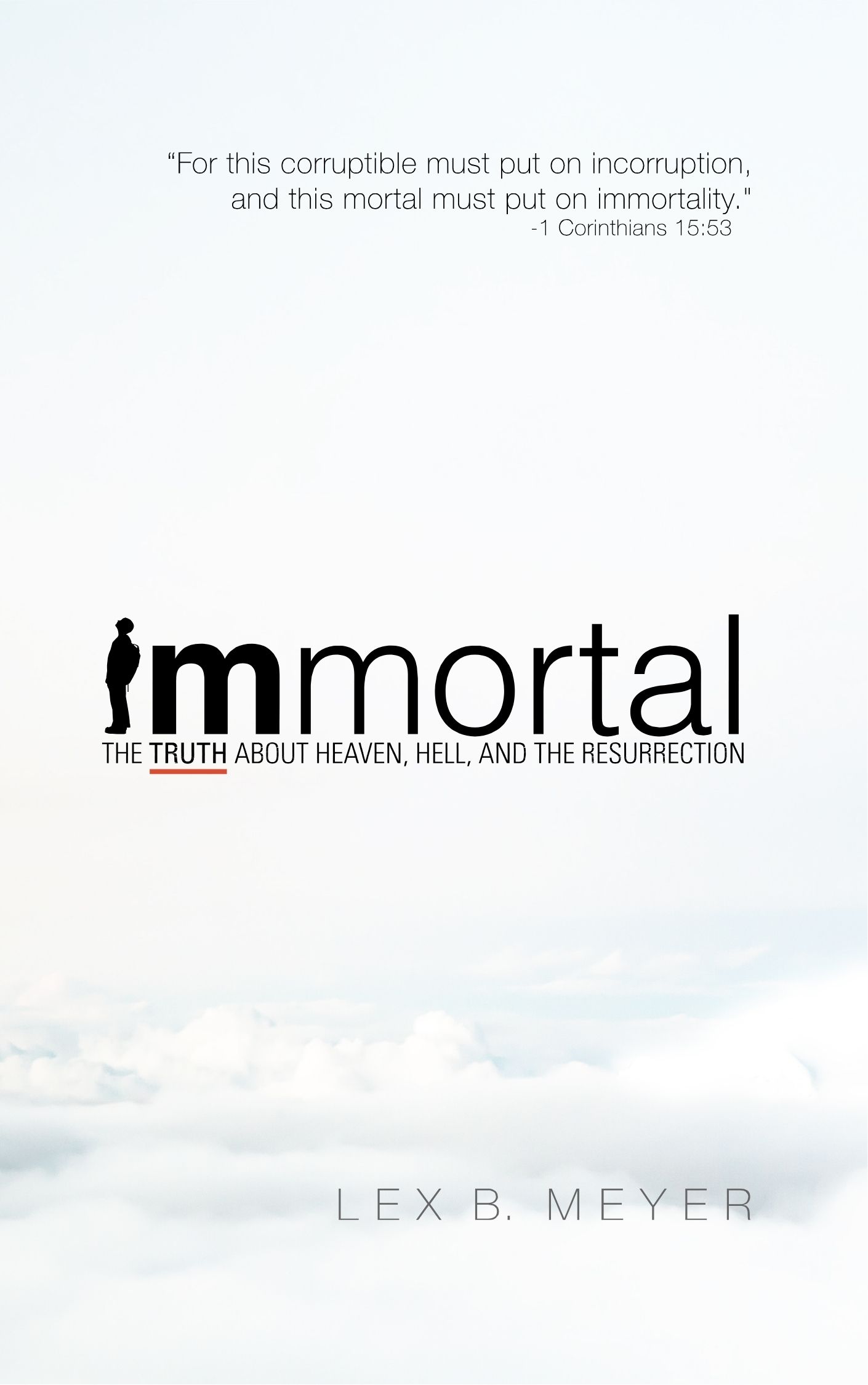
Immortal
The Truth About Heaven, Hell, and the Resurrection
This second edition has been edited and reformatted for easier readability and has been expanded upon, revised, and updated for more depth and clarity. We hope you will enjoy this second edition of Immortal even more than the first. Find out what the Bible really says about Eternal Life! Did you know that many of the popular Christian beliefs about eternal life are not based on the Scriptures, but actually come from pagan origins? Learn the Biblical truths about life after death, and why the gospel message is so important!
As an Amazon Associate I earn from qualifying purchases.
The Investigation
What Is Immortal About?
There have been many books written on life after death, most of which take a subjective approach, speaking about things such as out-of-body and near-death experiences. In a number of these books, the author(s) even claim to have personally visited heaven or hell (or both) and returned to tell about it. This is not one of those books.
This book is a Theological dissertation about eternal life, and its purpose is to highlight biblical perspectives on heaven, hell, and the resurrection. I cite several historical sources, in addition to an abundance of scriptural references, which all support my thesis. I will also demonstrate that first-century believers did not hold the popular beliefs about life after death that we see today.
My greatest desire in writing this book is to reveal the truth about what the Bible teaches concerning eternal life and the resurrection of the dead. It is my pleasure to share with you the power of the resurrection, and I hope it transforms your life as it has my own.
This second edition has been edited and reformatted for easier readability and expanded, revised, and updated to provide greater depth and clarity. We hope you will enjoy this second edition of Immortal even more than the first.
Inside the Book
- CHAPTER 1 LIFE 9
- - LIVING SOUL 9
- - SPIRIT OF LIFE 15
- - LIFE BLOOD 22
- - GREEK INFLUENCE 25
- CHAPTER 2 DEATH 31
- - COMMON ENEMY 31
- - I’M MORTAL 33
- - THE GRAVE 40
- - HELL CONFUSION 45
- - ONLY SLEEPING 56
- - IN HEAVEN 62
- - COMFORT IN MOURNING 70
- - FEAR OF DEATH 72
- CHAPTER 3 RESURRECTION 78
- - A FOUNDATIONAL BELIEF 79
- - BAPTISM 84
- - THE GOD OF THE LIVING 94
- - THE GATES OF SHEOL 97
- - DISTINCTIVE DOCTRINE 100
- - BORN AGAIN 104
- - FIRSTFRUITS 110
- - THE HARVEST 113
- - IMMORTAL 119
- - THE GOSPEL 125
- CHAPTER 4 THE KINGDOM 132
- - A HOLY NATION 134
- - GREAT FAITH 138
- - PARABLES 142
- - LEAST AND GREATEST 146
- - THY KINGDOM COME 151
- - ENTER THE KINGDOM 156
- - CONSTITUTION OF THE KINGDOM 162
- - MILLENNIAL KINGDOM 167
- - THE REBELLION 174
- - GREAT WHITE THRONE 178
- - THE WORLD TO COME 185
- CHAPTER 5 QUESTIONS 190
- - ELIJAH IN HEAVEN 190
- - THE TRANSFIGURATION 199
- - ABRAHAM’S BOSOM 205
- - THIEF ON THE CROSS 210
- - ENOCH 212
- - ABSENT FROM THE BODY 217
- - ETERNAL FIRE 221
- - RESURRECTED SAINTS 223
- - UNDER THE ALTAR 226
- - THE RAPTURE 229
- - PURGATORY 239
- - WITCH OF ENDOR 243
- - NEAR-DEATH EXPERIENCES 252
- FINAL WORDS 256
Read a Sample
Living Soul
Popular ideas about life after death center around the concept that a person’s identity, consciousness, or soul continues to exist after the death of their body. This idea has been highly popular throughout history, particularly in Egyptian theology and Greek philosophy. Most religious and philosophical views on the afterlife suggest that it occurs in a spiritual realm, rather than a physical one. But what does the Bible have to say about life after death?
To gain a correct biblical understanding of life and death, we must start at the beginning. I am convinced that our understanding of the events in Genesis profoundly influences our understanding of everything that follows. If we neglect the foundation of Genesis, then we will have difficulty understanding everything else.
Genesis means “beginning”, and it was given to us as a foundation for our faith. The first few chapters of Genesis explain the origin of life, the cause of death, and the need for salvation. We need to know how life began so that we can better understand how it ends. Look at how the Bible describes the creation of man:
“And the Lord God formed man of the dust of the ground, and breathed into his nostrils the breath of life; and man became a living being [nephesh].” – Genesis 2:7
The Hebrew word “nephesh,” translated above as “living being,” can also be translated as “soul,” which is how the King James Version translates it. The New Strong’s Complete Dictionary of Bible Words defines nephesh as “a breathing creature”[1], and it goes on to describe it as any appetite, beast, body, creature, desire, life, lust, man, mind, mortality, person, pleasure, or self. The basic idea is that a nephesh is a body with the breath of life, but it also refers to the natural desires of that body.
We are familiar with this usage of the word soul in phrases like “there was not a soul in the place”, indicating that not a single person was there. Another familiar phrase is, “I won’t tell a soul”, suggesting that you won’t tell anyone. We also use words like “I am bearing my soul to you”, indicating that you are sharing your deepest desires and innermost thoughts with someone.
The previously mentioned verse in Genesis describes the creation of Adam, and it was universally agreed upon by the early Church Fathers that God directly created Adam's soul. However, there have been some disagreements about the origin of souls that were born after Adam. There are three main theories about the origin of the soul: creationism, Traducianism, and pre-existence.
Creationism teaches that God creates a soul for each body at conception. This means that every time an embryo is formed in a womb, God actively creates a soul and breathes life into the person. Creationism appears to have been the predominant belief in Eastern Christianity, whereas Traducianism was more prevalent in the West.
Traducianism teaches that a person’s soul is derived from the souls of their parents. This teaching is based on the idea that Adam’s soul was created directly by God, and then Eve’s soul was formed from his. When Adam and Eve conceived Cain and Abel, their souls were derived from the combination of Adam and Eve. This theory seems to help explain the transmission of original sin.
Both creationism and Traducianism explain that a human soul comes into existence at the moment of conception. However, the pre-existence theory teaches that every individual soul existed before conception, and enters the body sometime before birth. Some adherents to this theory believe the soul is also eternal.
It is important to note that Greek Philosophy, Hinduism, and Mormonism all affirm the pre-existence of the soul. At the same time, it has been commonly denied in both Christianity and Judaism throughout history.
Hindus and Mormons also believe in the immortality of the soul, not just pre-existence, but the eternal existence of the soul. According to this theory, every person has always existed eternally with God or as a god. (I bring this up to show the difference between the Bible and other religions.) According to Hinduism, Krishna said, “Never was there a time when I did not exist, nor you, nor all these kings; nor in the future shall any of us cease to be.”[2]
The idea that we have an immortal soul plays well into the Hindu belief in reincarnation. They believe that every person continues on an endless cycle of death and rebirth until they reach the final point of liberation. They desire to end the cycle and cease to exist. To them, salvation is the end of life, but for those who believe in the Bible, salvation is the gift of eternal life.
Similar to Hinduism, the Mormon Doctrine and Covenants states, “Man was also in the beginning with God. Intelligence, or the light of truth, was not created or made, neither indeed can be.”[3]
Mormons believe that we are co-eternal with God and that our souls have always existed with God. If we are immortal beings that have always existed eternally, then we were not created. When you say that humans have an immortal soul, you are essentially saying that we are gods. This doctrine is completely unbiblical and has no place in Christian thought. The Bible clearly states that only God is immortal.
“…He who is the blessed and only Potentate, the King of kings and Lord of lords, who alone has immortality, dwelling in unapproachable light, whom no man has seen or can see, to whom be honor and everlasting power. Amen.”
– 1 Timothy 6:15, 16
This is why it is so crucial for us to understand the Biblical account of creation. The Bible tells us that man was created and that he “became a living soul”. We did not exist eternally in an incorporeal state before putting on flesh, to live a short earthly existence and later return to life without a body. The Bible tells us that we were created with a body, and we did not exist before the formation of our flesh.
By saying we have an immortal soul, we are robbing Yeshua of his glory and exalting ourselves as equals with Christ! He is the only pre-existent soul to put on flesh; we were created in flesh, but He descended from heaven and put on flesh and dwelt among us. This is one of the glorious mysteries about the nature of the Messiah, and by claiming that we share in his pre-existence, we diminish Him. Listen to what Paul said about the nature of the Messiah.
“…who, being in the form of God, did not consider it robbery to be equal with God, but made Himself of no reputation, taking the form of a bondservant, and coming in the likeness of men. And being found in appearance as a man, He humbled Himself and became obedient to the point of death, even the death of the cross. Therefore God also has highly exalted Him and given Him the name which is above every name, that at the name of Jesus every knee should bow, of those in heaven, and of those on earth, and of those under the earth, and that every tongue should confess that Jesus Christ is Lord, to the glory of God the Father.” – Philippians 2:6-11
Mormons have no problem with the idea of an immortal soul because they consider themselves to be co-eternal with Christ. Their theology leads them to believe that they can be gods too someday. However, if we take the Biblical account of creation seriously, then we cannot conclude that we are anything more than created beings.
It is also important to note that humans are not the only creation the Bible calls “nephesh”. Several verses in Genesis refer to the creation of other creatures and specifically use the word nephesh to describe them.
“Then God said, ‘Let the waters abound with an abundance of living creatures [nephesh], and let birds fly above the earth across the face of the firmament of the heavens’ So God created great sea creatures and every living thing [nephesh] that moves, with which the waters abounded, according to their kind, and every winged bird according to its kind. And God saw that it was good.” – Genesis 1:20-21
“Then God said, ‘Let the earth bring forth the living creature [nephesh] according to its kind: cattle and creeping thing and beast of the earth, each according to its kind.” – Genesis 1:24
Many people mistakenly believe that only humans have a soul, while animals do not. However, according to the Bible, everything that has the breath of life is considered a living soul. Simply put, a soul is a living creature. This stands in contrast to inanimate objects, such as rocks or plants, that were not given the breath of life. In fact, according to Genesis, even reptiles and insects are living souls. This not only helps us to better understand what a soul is but also what it is not; specifically, that a soul is not unique to human beings. Some people find it challenging to grasp the idea that every living thing is a soul because their current understanding of the word “soul” prevents them from seeing it.
We all have a specific lens of interpretation that we use when reading the Scriptures. It could be a denominational bias or a particular philosophy we hold that distorts our understanding of certain Biblical truths. Whatever it might be, each person needs to learn for themselves how to remove these blinders and read the Bible with fresh eyes, letting the Bible interpret and explain itself.
[1] Strong, J. (1996). The New Strong's Complete Dictionary of Bible Words. Nashville, TN: Thomas Nelson Publishers.
[2] Bhaktivedanta Swami Prabhupada, A. (2001). Bhagavad-gita As It Is, Deluxe. Los Angeles, CA: Bhaktivedanta Book Trust.
[3] The Church of Jesus Christ of Latter-day Saints. (2013). The Book of Mormon, Doctrine and Covenants, and Pearl of Great Price. Salt Lake City, UT: The Church of Jesus Christ of Latter-day Saints.
Examine the Text
Related Scripture

About the Author
Lex Meyer
Pastor, Bible teacher, author, and creator of UNLEARN the Lies.
Lex has a degree in Theology and has devoted most of his life to studying and teaching the Bible. He is the pastor of the Grafted Church in Tryon, OK, where he teaches people to embody the great commandment and embrace the great commission. Lex is also the founder of UNLEARN, a ministry that focuses on seeking the truth and exposing the lies we have inherited.
Learn more about the ministry →